
Last weekend, we completed the loading of three 40HC containers of hot-dip galvanized stacking racks. This client has placed repeat orders with us on numerous occasions and holds our product quality in very high regard.
Typically, the surface treatment of stacking racks falls into two categories: powder coating and galvanizing. Galvanizing, in turn, can be further classified into three types: the first involves manufacturing the racks directly from pre-galvanized materials; the second involves manufacturing the racks using standard materials and subsequently applying an electroplated finish (also known as cold galvanizing); and the third involves applying a hot-dip galvanized finish to the racks after their manufacturing is complete.
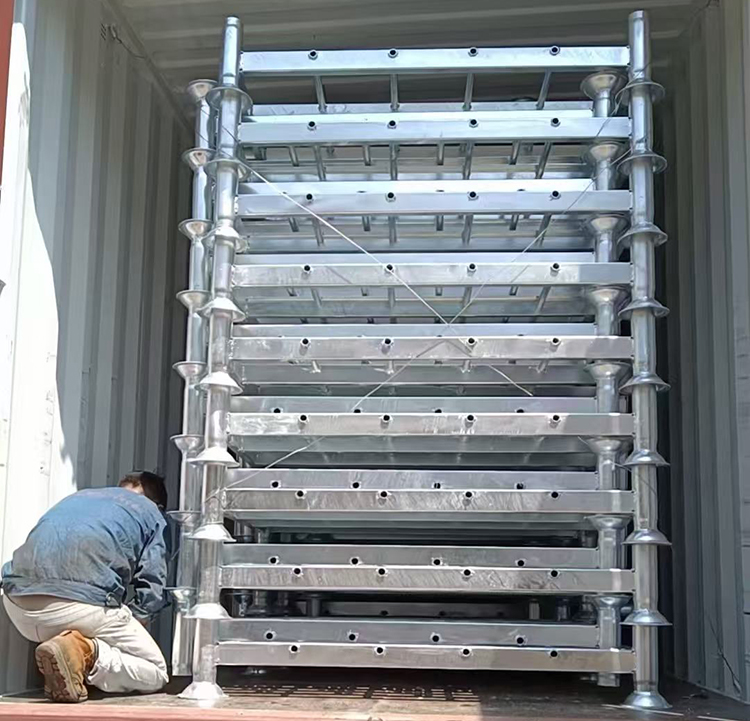
The shipment currently being loaded consists of hot-dip galvanized stacking racks. These racks measure 1300 x 930 mm, feature a load capacity of 1 ton per level, and can be stacked up to 3 or 4 tiers high. Customers may place goods directly onto the racks for stacking; alternatively—particularly for smaller items—goods can first be arranged on pallets, which are then placed onto the stacking racks, depending on the customer’s specific operational requirements. Furthermore, both the dimensions and load capacity of the racks are fully customizable to suit the size of the goods being stored.
We are able to provide our clients with all of these surface treatment options, with the choice depending on the specific application environment as well as the client’s personal preferences. Generally speaking, hot-dip galvanized stacking racks entail a slightly higher cost. However, they offer the strongest resistance to corrosion and rust, making them suitable for use in cold storage facilities as well as outdoor settings; they will not rust, regardless of exposure to wind or rain. Naturally, they are also perfectly suitable for indoor use. For standard indoor environments at ambient temperatures, we typically recommend powder-coated stacking racks, which are relatively more cost-effective.
Post time: Apr-20-2026