
Heavy duty wire mesh decking racking systems consist of upright frames, beams, and wire mesh decking. Wire mesh decking are typically used in two specific situations, as pallets can usually be placed directly onto the beams.
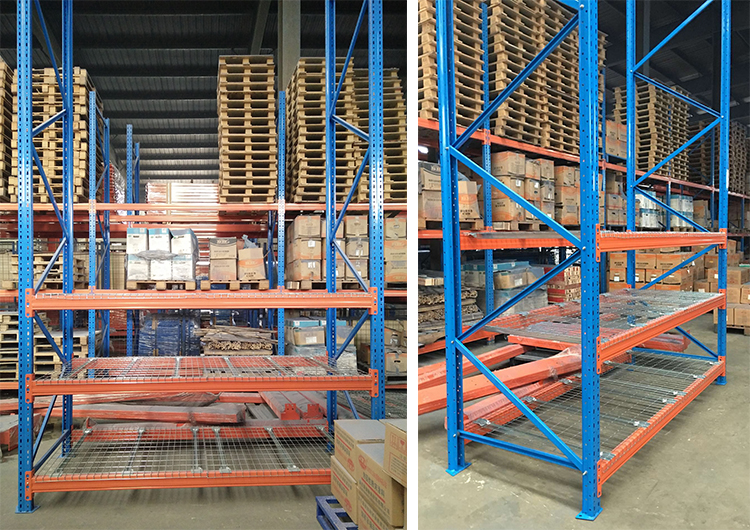
First, let’s consider the first scenario:
When the racking height is not high and the load per level is not very heavy, forklifts are not needed for retrieval, and pallets are not required for storage. Goods can be placed directly on the racking, in which case wire mesh decking can be used. The goods can be placed directly on the wire mesh decking. In this situation, the wire mesh decking plays the main load-bearing role, so materials with good load-bearing capacity will be chosen, and there will be more reinforcing ribs at the bottom.
The second scenario involves using both wire mesh decking and pallets. Sometimes the racking load is heavy, sometimes it’s lighter, but it definitely requires forklift operation. The height is customized. In this case, the wire mesh decking doesn’t bear the main load; it serves an auxiliary load-bearing function, as the main load-bearing points of the pallet are still on the beams. In this situation, the wire mesh decking material can be lighter. Regardless of the required racking load, standard wire mesh decking is sufficient, primarily to prevent goods from falling off the pallets, acting as a protective measure.
Wire mesh decking is an important component in the racking industry, and whether or not it’s needed depends on the customer’s specific requirements. The number of wire mesh decking per level is usually related to the length of the beams. The length of the wire mesh decking is typically around 1000-1200mm, while the width is usually similar to the width of the racking unit, slightly longer so that the ends can be securely fitted onto the beams.
Post time: Feb-03-2026